
Teatsealants as a Mastitis Preventative at Dry Off

The use of antibiotics in agriculture will continue to come under increasing pressure.  The World Health Organisation has concerns about the use of antibiotics in animals and the risk of antimicrobial resistance transferring into the human population.  Dry cow antibiotic preparations have become an area of significant scrutiny.  Already dairy farms in some European Countries can not use antibiotic dry cow preparations unless the individual cow can be demonstrated to have an infection - i.e. a high SCC from a herd test.

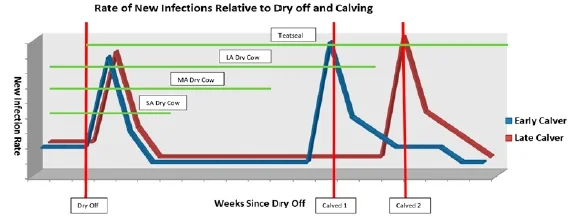
We have had many farms last season that took the step to use Teatseal only in cows with herd test SCCs consistently below 150,000 for the season.  When administered hygienically Teatseal will significantly reduce the risk of picking up new infections at dry off and close to calving.

In the graph below from a local farm, clinical mastitis cases have been recorded from cows which either received Teatseal or Antibiotic Dry Cow Therapy.  Those that received DCT (not Teatsealed) had a higher rate of mastitis in the following season, but it must be remembered that being high SCC cows they have more risk factors for picking up new infections in the next season.  The Teatseal treated cows had extremely low levels of recorded clinical mastitis in the first 2 months of lactation.
Setting Your Herd and Your Farm Up for Ease and Low Cost Next Season

We are having regular conversations with our clients around dry cow strategies.  Cost reduction is at the forefront of everyone's minds at the moment but it is important that a plan is implemented that will not severely compromise milk quality, clinical mastitis and put additional pressure on the farm team next winter/spring.

An extreme case example from last season was a local farm that had used whole herd Cepravin in the previous year, maintained a BMSCC under 100,000 for the whole season and so elected not use DCT therapy in any cows at the end of last season.  Subsequently the equivalent of 25% of the herd was treated for clinical mastitis over the dry period, meaning the shed could not be shut down.  Over the ensuing 10 months, the equivalent of 100% of the herd has been treated for clinical mastitis.  The result has been massive cost and massive stress.

All cows - even low cell count cows, are at risk of developing mastitis post-dry off if the correct preventative measures are not taken.

Our advice would be to ensure every teat is treated.  If budget constraints are tight and you are considering treating just a few high risk cows with long acting products e.g. Cepravin, we would suggest that you would be better to spend the same amount on more cows with short acting products (or sealants).

Important Considerations

  • Know what the risks and benefits are of the therapy/sealant you choose; actives, formulations, length of action and spectrum of activity are highly variable between products.
  • Will you have less staff available in the shed next season if things go wrong?
  • What will the environmental challenge be like for your herd over the winter/spring?
  • Is your BMSCC climbing or higher than you are comfortable with?

Lungworm - The Perfect Storm

Vets from our Waimate clinic were recently called to a farm where 4 calves had died, one calf was recumbent, and about 40 others showed signs of coughing and respiratory distress.  The history was consistent with lungworm, and this was subsequently confirmed on postmortem (see photo below) where large numbers of adult worms were present in the large airways of the calf.  We rarely see clinical lungworm cases, but this case saw a perfect storm; wet weather, long drenching intervals, and calves on the same paddocks for multiple years.

The lungworm lifecycle, much like gastrointestinal worms, revolves around the ingestion of L3 larvae from pasture.  Grazing paddocks which have previously held calves (as in this case) will obviously increase the risk of infection.  However L3's from lungworm are relatively inactive compared to their gastrointestinal cousins, and are incapable of traveling more than 5cm from the cow pats they are carried in.  Instead they rely primarily on a mushroom (P klenii) which grows in the cow pats and bursts to disperse the larvae as far as 3m.  The recent wet warm weather has been perfect mushroom weather, and has therefore increased the risk of lungworm.

A routine drenching programme normally limits lungworm as they are highly susceptible to anthelmintics.  In particular pour-on abamectin compounds (such as Eclipse) have a persistence efficacy of over 14 days.  In this case, in an effort to reduce costs the farmer used an oral abamectin/levamisole drench 8 weeks apart.  We traditionally recommend 4 weeks between oral drenches and up to 6 weeks for pour-on products at this time of year.

This case highlights the need to be aware of drenching intervals in young stock, particularly with the warm, wet weather we were experiencing.  As in all diseases prevention is much better than cure.  In this case the farmer has lost 4 calves, has another 40 severely compromised, and the whole mob will have reduced growth rates - severely outweighing the cost of an extra drench.  Talk to your Prime Vet about a Young Stock Health Plan if you don't already have one in place.

Polio Encephalomalacia (P.E.)

We are once again seeing several cases of P.E. (polio encephalomalacia), a nervous disease seen primarily in calves and younger stock.  P.E. is caused by a lack of vitamin B1 (not to be confused with a cobalt deficiency, which is associated with a vitamin B12 deficiency).  P.E. is thought to be nutritionally induced, when there is a sudden change in diet from stalky, higher DM diet, to a lush, low fibre diet.  A high dietary sulphur intake, especially with brassica's, has also been incriminated as a cause of P.E.

Calves with P.E. appear blind, may walk aimlessly, appear wobbly, have muscle tremors and head press.  If calves are treated early in the disease process with a series of vitamin B1 injections, survival rates are good.  In an outbreak situation we have had good success, by prophylactically treating the remaining, unaffected calves, in the group with an oral vitamin B1 drench.  This has proved a very cost effective preventative measure.

Healthy Hoof Update

Lame cows continue to be among the three main problems affecting farms in our area together with mastitis and reproduction.

Lameness figures on local farms range from 5-25%, but there is still a significant problem with under-recording of lameness and under-estimating its importance and control.

Early detection and treatment of lameness problems remains the best solution.  The Veterinary Centre has been running Healthy Hoof programmes on many farms with lameness issues this season.  Having staff trained by one of our vets so that they are competent and confident with lame cow treatments and understand the causes of lameness has made huge differences to lameness on these farms. 

An influx of lame cows over the Christmas and the New Year period will sound familiar to many farmers, these can be challenging to deal with as many farms go onto skeleton staff with public holidays and annual leave.

We ask you to be proactive if you are seeing an increase in the number of lameness cases.  Do not hesitate to organise a lameness consult with a member of our team.