
The First Month of Lactation - Minimising Negative Energy Balance

The management of the first month of lactation beyond the colostrum period very critical for herd level performance. Most cows will spend this period in negative energy balance (NEB). This is why providing consistently high feed quality is imperative. What we have learnt from cow collars is that farms that are having low rates of pre-mate heats four weeks before planned start of mating will still be low just before mating.

Cows in significant negative energy balance may develop clinical or sub-clinical ketosis. Fats mobilised (NEFAs) will also damage and therefore reduce the fertility of developing eggs on the ovaries.

Cows which are well fed/have a good appetite in the first month of lactation will lose less weight and have better mating performance. Consider the following:

  • Optimal pre-graze covers of 3,000 to 3,400 kgDM/ha in the first round will ensure good quality and easy harvest for the cow, while maintaining a residual at 1,550-1,600kgDM/ha.

  • Know what your daily cow requirement is and calculate your allocation every day - where feed deficits exist on any given day fill it with appropriate supplement.

  • If the herd or part of the herd is skinny and there are large feed deficits ahead, production may be best sacrificed by OAD milking for up to 3 weeks to maintain BCS leading into mating.

  • Use monensin (Rumenox), to increase feed conversion efficiency, by driving propionate production. Clinical trials show boost in milk protein production and far less BCS loss. Use strategically from calving up until end of mating.

  • Internal parasites – the biggest impact these have is on appetite suppression. Almost all farms will have high levels of over-wintered larvae this year. Aim to drench your herd by early/mid-September.

  • Vitamin B12 – is a requirement for energy extraction. Deficient cows will lose appetite. We see B12 levels drop at the same time as spring grass goes lush. This is partly due to rapid transit times through the gut impeding B12 absorption. Rule of thumb “when faeces start becoming loose look to give Vit B12”.
Emergency Treatment of Lice in Spring

Cows with heavy lice infestation are up to 10% less productive due to eating less, because they are distracted or itching.

Lice are the most important winter parasite of cattle; you will see a lot of scratching and hair loss over the neck and shoulder. I strongly believe that severe lice infestations do cause milk production and BCS loss in dairy cattle. Furthermore, lice burdens are often highest in cattle which are in poor condition and have been tight for feed over the winter.

While it would have always been better to have treated cattle for lice in early winter a salvage treatment can still be used in the spring. The critical thing is to dose all cattle with an effective dose and product.

Product choice becomes vitally important as we head into spring due to both the milk and bobby calf with holds.

Pour on “Mectin” treatment options- These treat both lice and internal parasites:

  • Cydectin is the logical choice in this situation as it achieves good control of both lice and internal parasites. It has the advantage of both a nil milk and meat withhold. The bobby calf meat withhold is also nil.

  • While pour-on drenches containing Abamectin are great options for controlling lice MPI implemented a new milk and meat with holding time of 35 days in Sept 2022. This means Reflex and Topline are largely restricted to being used as dry off treatments in the autumn.

Pour on lice only treatment options:

  • Blaze is a synthetic pyrethroid pour-on which has a nil milk withhold and 28-day meat withhold. There is no bobby calf withholding period.

  • Destruct is a pour-on organophosphate which has a 3-day meat withhold and 5-day milk withhold.

It is important to be aware that when any of these pour on products are applied to cattle that have come straight off crop and have thick coats covered in mud or faeces, then efficacy may be compromised. Lice numbers will rebuild again over 8 weeks, often requiring another treatment.

The Winter Diet in the Last Month of Gestation

Over the last 10 years, management of the dry cow to attain optimal condition has been much improved. This has been mainly facilitated by setting realistic figures on crop utilisation (90% for FB and 80% for Kale in good conditions) and ME requirements for condition gain (70MJME/kg liveweight gain), maintenance (60MJME) and pregnancy (30-50MJME – 6 to 2 weeks from calving). Also factor in the increased requirements due to wet, wind chill and mud which can add an additional 10-30MJME/day.

Ensure that cows are not getting over-fat or are at risk of not achieving target. A BCS (from your vet) at the start of July can tell you whether intakes need to be increased or decreased.

The winter diet for a pregnant cow, through until about the last 3 weeks of pregnancy, requires about 11% crude protein in the diet (or 1.2-1.4kg of crude protein). As well as cow’s normal base protein requirements, she has the demands of a rapidly growing calf, the development of new udder tissue and production of colostrum antibodies. Cows under protein stress for significant periods of time will break down their own tissues to meet foetal demands, but the end result may be muscle loss (calving difficulty), poor udder development, poor colostrum quality and poor cow immunity (placing her at greater risk of mastitis or metritis).

Optimal crude protein requirements increase to >16% in the last 3 weeks before calving. Typically Fodder beet bulbs have crude protein levels less than 10%, whereas the leaf is in the 15-20% range. If the crop you are feeding is losing leaf yield in July, ensure that cows are receiving an additional supplement that has higher protein content.

Brassica Feeding over the Dry Period – The Good, the Bad and the Ugly

Next to fodder beet, brassicas (rape, kale, turnips and swedes), are the other mainstay of the winter diet. It helps to understand some of their properties to get the best from them.

The Good

  • In kale, the upper 2/3rd of the plant has quite good ME – being about 12.5MJ. The lower part of the plant (the stalk) will be lower and is only about 7ME close to the ground. The overall ME is about 11-11.5MJ/kgDM. The ME of all other brassicas are closer to 12MJME.

  • Generally speaking, brassicas have good levels of crude protein for a dry cow – 14- 18%. This makes it quite a good crop to finish the winter on if you have had cows on a low crude protein fodder beet through the early part of the dry period.

  • Kale/Rape have high levels of calcium – about 3 times what is in grass and 9 times what is in fodder beet bulbs. This makes it handy for replenishing bone stores in dairy cows.

  • A tall grazing face can form good shelter for cows if being grazed in a southern direction.

The Bad

  • Kale crops often have bad utilisation in bad weather – it can be as low as 50%. Make sure you allow for this.

  • Best practice is to work on 80% utilisation in good conditions. If it is higher than this, cows are probably being underfed. Make sure you factor this in on your daily allocation.

  • All brassicas are low in effective fibre (and yes that includes those chewy looking stalks). This is the reason that as a minimum 25% of the diet needs to have a long fibre source – e.g. straw, hay or baleage.

  • Animals often ingest quite a bit of mud while on crop – this will deplete copper stores. Selenium is also consumed/depleted soaking up ‘free radicals’ created by a high content of poly-unsaturated fatty acids.

  • Swedes can be quite hard, making it tough for calves and heifers to eat. It can tend to be lower in crude protein as well.

The Ugly

  • The lack of effective fibre and if fed frozen can make cattle prone to frost bloat (a free gas bloat). The cold temperature shocks the rumen disabling the ability to belch. Wait for the frost to come off before feeding.

  • Brassicas will bind up Iodine which can result in still births in calves – particularly out of heifers. Dosing a trough with stock iodine on a daily basis in the last month of gestation may reduce this risk.

  • Nitrate poisoning is a real danger - particularly in rape followed next by kale. Its most likely to occur after periods of cold, low light conditions, where leaf loss has occurred from previous breakouts, and when animals go onto a frozen crop with an empty belly.

  • Like fodder beet, swedes can cause acidosis. A transition period is also important.

Bovine Adenovirus (BAdV) in R1 Dairy Calves

HISTORY

We recently had a case of BAdV confirmed in a mob of 140 rising yearling dairy replacements. Five rising yearlings had died over a period of 3-4 days. Unfortunately, four of them had died over the previous 24-48 hours during a very warm spell of weather, and when found were too autolyzed to postmortem. The fifth calf, noticed late the next day, was acutely unwell, and subsequently examined, treated and blood tested/faecal sampled. The calf had a high temperature, dull demeanour, dehydrated, diarrhoea and unable to stand unaided. This calf died overnight. The mob’s drenching history was up to date, and unlike a lot of reported cases of BAdV, where the mob has been unwell, the remaining calves appeared in ‘good health’.

THE DISEASE

BAdV is a relatively uncommon disease – but was noted as a disease of increasing occurrence in rising yearlings in a national review 10 years ago. It is a viral disease that is mainly seen in 6-12 months old calves. Outbreaks, usually with low mortality rates (1-3%) can occur during autumn, winter and spring months, and often post weaning. It is primarily an acute gastro-intestinal disease, but calves may also have respiratory signs.

Adenoviruses are transmitted in nasal and oral secretions and faeces. While many cattle are infected, only a small proportion develops disease, which are animals usually immuno-compromised or have concurrent BVD infection. Common differentials for BAdV are Yersinia, Salmonella, BVD/mucosal disease, GI parasites, and other causes of acute death – nitrate poisoning, clostridial disease or toxicity.

DIAGNOSIS

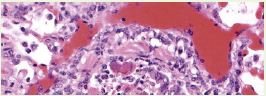
Until recently, the main way to diagnose BAdV, has been getting good quality bowel samples and doing histopathology – and seeing the classic inclusion bodies, of this disease. However, a PCR (looking at genetic material) blood test is now available – and markedly assists us with the diagnosis. The fifth calf was positive for BAdV, and it was assumed it was also the cause of the other four calves that died.