Calf Health and Management

We are more and more aware of the impact our heifers will have on the future success of our herd. Getting valuable replacement heifers off on the right foot in the pre-weaning period is a crucial step in bringing in top quality,  well grown heifers as two year olds.

The Veterinary Centre can offer a full range of calf health and management advice.

Dairy veterinarian and veteran calf rearer Nicola Neal can assist with the set up and design pf your calf shed systems and management. Nicola completed a Masters paper in "Calf Health, Disease and Management" last year and is keen to apply some practical on farm knowledge, along with the latest scientific advice. This service is tailored to suit the individual farm and could include on farm training of calf rearers', developing quality assurance systems wen you can not be there to supervise, developing calf health plans and making the most of facilities.

Do not wait for a problem to develop in the third week of calving when you have not got the time to deal with it, call now to book a time to review you calf shed systems.

Setting Your Herd Up for Success

If significant BCS gain is required over the dry period be realistic about what you need to feed your cows. As little body condition can be gained in the last month of gestation, feed maximally in the month of June to try and maximise this gain.

A cow putting on 1 BCS in the month of June will require about 7kg DM/day above maintenance and pregnancy requirements compared to a cow already at target.

  • For every BCS below a 5 at point of calving, cows will tend to produce 12-20kg of MS less for the season.
  • For every BCS below a 5 at point of calving cows will tend to take an additional 10 days to resume cycling.
  • Cows which do not have a pre-mate heat will have 10% lower conception rates when finally mated.
  • The target BCS for an individual cow at point of calving is 5.0-5.5. This is an extremely good looking cow. Her pin bones are no longer visible (at all!), the rump is filled in, the hips are rounded, the spine is not visible (at all!), the short ribs are rounded and the long ribs are not visible (at all!).
  • It is thought that a large proportion of cows in New Zealand calve below target BCS.

Nitrate Toxicity Alert

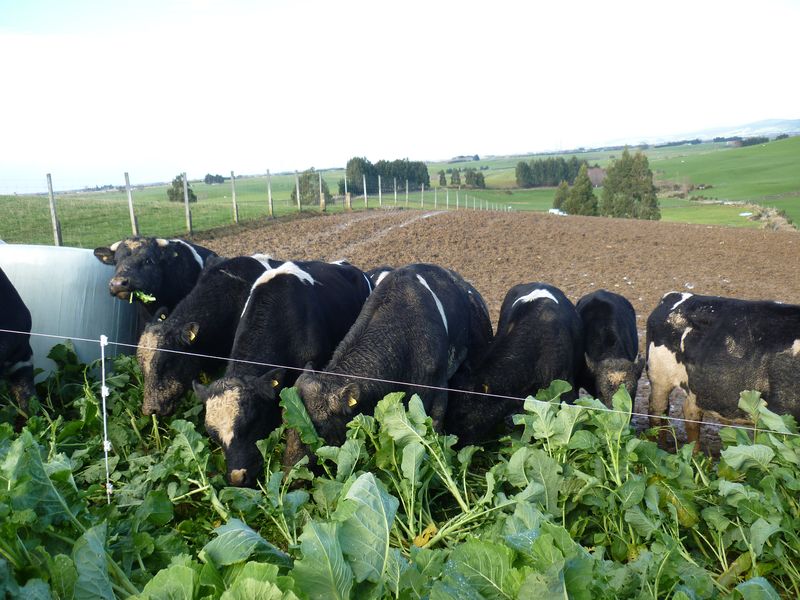
Brassicas (Kale, Chou, Rape, Turnips and Swedes), fodderbeet, Italian ryegrass and oats can all produce nitrate toxicity. Of this group, rape is the most notorious - winter rape crops continue to gain popularity in this area for heifer grazing.

Before introducing animals to crop this June, we urge that it be tested first.  Nitrate test kits can be purchased from any of our clinics, representing a cheap investment. Alternatively bring in samples to be tested by our staff.

Targetting BCS 5.0 at calving

It is a well known industry target that cows should be a minimum of 4.5 at dry off at the end of May - preferably 4.7, so the cows only have to gain 0.5 of a BCS over winter, to reach the desired target of 5.0 to 5.5 condition score at the point of calving. Cows at BCS of 3.5 should be dried off now. Cows less than 3.5 are unlikely to get to BCS 5.0 by calving even if maximally fed. Remember some supplementary feeds are better at partitioning to BCS than other - maize, barley (cereals) and as we see on a lot of farms now, fodderbeet.

Ideally cow wintering groups would be made up according to calving date  - however if your herd BCS is wide, as is commonly the case, it is suggested to winter the bottom portion of the herd separately and feed these preferentially. You may wish to consider making up wintering groups based on a combination of both BCS and calving date. Our practice can offer a service where we can individually BCS cows and match these with their predicted calving dates. Cows are then split into early calving skinnies, early calving fats, late calving fats etc. Sheds fitted with Protrak makes drafting simple! Also with the current wet weather, the number of lame cows on some farms is increasing, so decisions on dry off and BCS may be brought forward to allow for developing lameness issues.

Phantom Cow Syndrome

Last year our practice conducted a large scale study looking at the incidence of phantom cows and the economics of treating them. A phantom cow is a cow which has had one insemination and does not return within 35 days post insemination but is found to be not pregnant by ultrasound scan. 

In our study 4200 non-returning cows from 14 farms were scanned. On average 10% of non returning cows were found to be not pregnant. (14% in previously CIDR treated cows and 8% in naturally cycling cows).

The risk of a high incidence of phantom cow syndrome increases with a herd history of large condition loss post-calving, metritis, high non-cycler rate, high blood NEFA levels post calving, low BCS at mating, metritis and BVD. In our study half the cows diagnosed as phantoms were treated with a CIDR and the other half were left. We wanted to see if early identification and treatment would lift the 9,10 and 13 week in-calf rate.

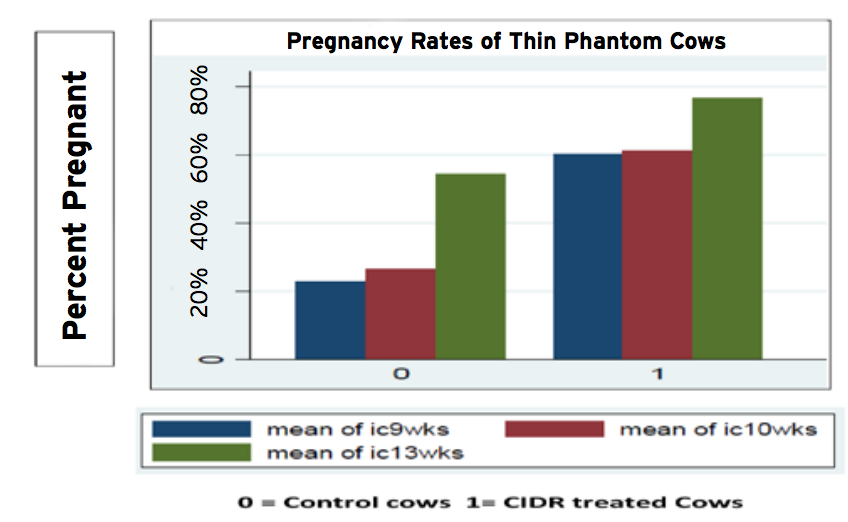
On average CIDR treated phantom cows had an increased 9 week in-calf rate of 20%, but the biggest response came from the treatment of phantom cows of BCS 4.0 or less. Treatment of these increased 9 week incalf rates from 25% to 60% in these thin cows (half the cows in the study were 4.0 or less). The economic return for intervention on one farm in the study (900 cows) was $21,000.

Last year our practice conducted a large scale study looking at the incidence of phantom cows and the economics of treating them.

A phantom cow is a cow which has had one insemination and does not return within 35 days post insemination but is found to be not pregnant by ultrasound scan.

Pregnacy-rates-of-thin-phantom-cows.png

In our study 4200 non-returning cows from 14 farms were scanned. On average 10% of non-returning cows were found to be not pregnant. (14% in previously CIDR treated cows and 8% in naturally cycling cows). The risk of a high incidence of phantom cow syndrome increases with a herd history of large condition loss post-calving, metritis, high non-cycler rate, high blood NEFA levels post calving, low BCS at mating, metritis and BVD.

In our study half the cows diagnosed as phantoms were treated with a CIDR and the other half were left. We wanted to see if early identification and treatment would lift the 9,10 and 13 week in-calf rate. On average CIDR treated phantom cows had an increased 9 week in-calf rate of  20%, but the biggest response came from the treatment of phantom cows of  BCS 4.0 or less. Treatment of these increased 9 week incalf rates from 25% to  60% in these thin cows (half the cows in the study were 4.0 or less). The economic return for intervention on one farm in the study (900 cows) was $21,000.